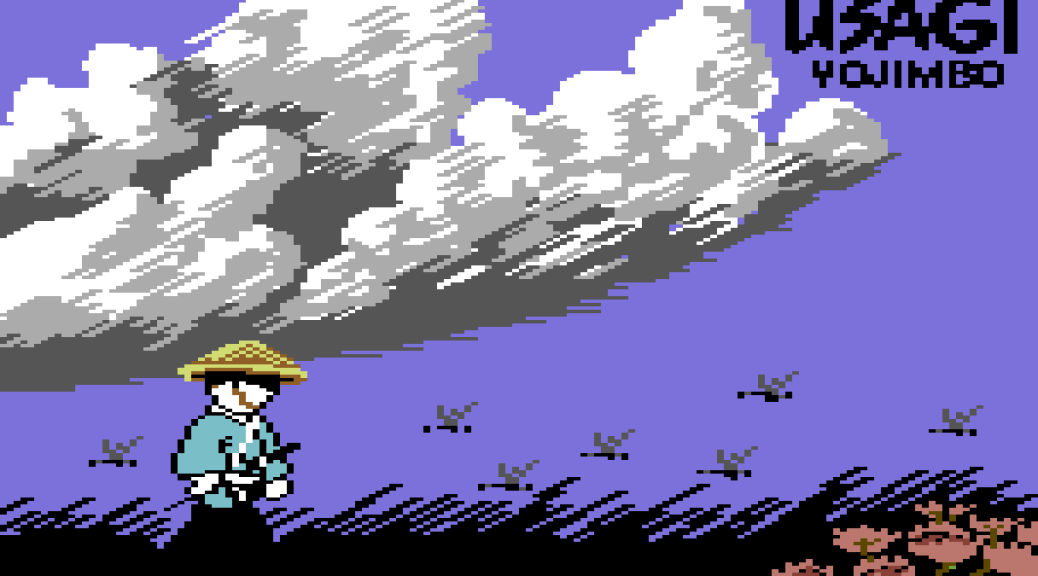
Also known by its more long-winded name: Samurai Warrior: The Battles of Usagi Yojimbo, this elegant fighting game was developed by Beam Software and first published by Firebird in 1988. Programming was by Doug Palmer; script was by Paul Kidd; graphics by Russel Comte, and music by Neil Brennan.
Usagi Yojimbo is a side-scrolling fighting game based on a comic book series by Stan Sakai. The comics were satirisations of modern Japanese cinema motifs, and the game follows the same course.
You play a samurai rabbit who is walking along a path, and must figure out who is going to attack you, and who isn’t. You don’t want to cut down an innocent farmer, but if it’s a bandit dressed as a farmer, waiting to ambush you… then you need to be prepared. And knowing how to use your sword is key to making it through the seemingly never-ending landscape.
Ninja will sometimes drop down from trees to attack you; nobles will set their guards onto you for not treating them with the appropriate respect. The appropriate respect being: to not walk around with your sword drawn in front of them. If you do that, they will attack you. You can avoid much of that by learning how to put your sword away when you don’t need it*.
*= How to put your sword away in Usagi Yojimbo: if you’re facing right and are playing with a joystick: push up/right and press fire to take out your sword, and push down/right and press fire to sheath it. If you’re facing left, push the up/down/left diagonals instead.
The scoring system in Usagi Yojimbo is based on ‘Karma’, and doing good deeds raises your Karma, while doing bad deeds reduces it. If your Karma reaches zero then your big, comedy rabbit will commit seppuku, right in front of you. And it’s game over. Lol.
The good deeds you need to do are:
Kill armed attackers.
Donate money to peasants and priests.
Rescue people.
The bad deeds you need to avoid:
Attacking peasants or priests.
Having your sword drawn in front of MOST non-hostiles – doing so will make them hostile. Some non-hostiles don’t seem to be bothered, though.
Farting in front of the ladies.*
There are times when fights are unavoidable, though, and the concise script keeps the story flowing.
Occasionally you’ll also encounter gaping chasms to jump across, and boss battles, and of course beating one of those counts as a good deed. You can also earn extra money (or lose what you have) at gambling dens at inns. Money (“Ryo”) can be spent on food to restore energy.
With well-designed, smooth-scrolling backgrounds, recognisable sprites, atmopsheric music, Usagi Yojimbo is definitely a C64 classic. The sword fighting, when you understand what to do, really is quite good. It’s all about one or two good swings to take down an opponent. Not fencing, or sword-whacking. Earlier enemies often don’t take too long to defeat, but later ones can. Which is why most people will play this with a trainer on, and I can understand why you might do that, but the game is more enjoyable if you play it without cheats and figure out how to fight properly. At first I dismissed it, but then I worked out how the combat worked, and managed to get quite far into the game. I think the designers should be commended for coming up with something different that worked. Even though not everyone noticed at the time of its original release.
Published by Thunder Mountain in the USA. Under the title “Thunder Mountain Action Pack, Vol. 1“.
There were also Amstrad and Spectrum versions of Usagi Yojimbo made.
*= I made that bit up. Sorry. 🙂
More: Samurai Warrior: The Battles of Usagi Yojimbo on Wikipedia
More Usagi Yojimbo (comic) on Wikipedia
More: Usagi Yojimbo on CSDb


 The King of Grabs