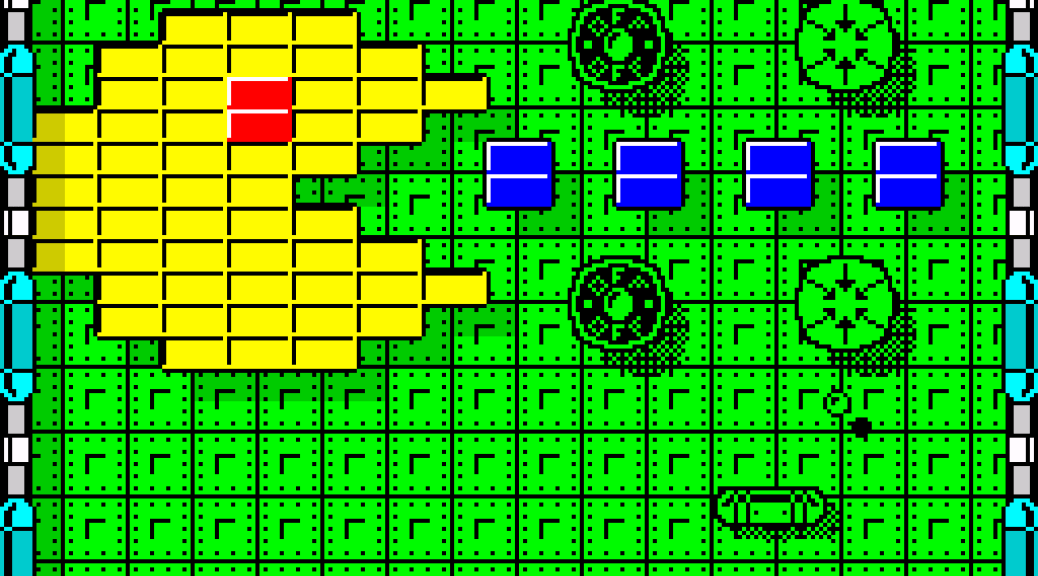
Written by Mark Crane and first published by Hit-Pak (the budget label of Elite Systems) in 1987, Batty is a clone of the games Breakout, and Arkanoid, but with a few of its own unique features.
The game was a minor hit on the ZX Spectrum and was also released for the Amstrad CPC and Commodore 64.
With games like this, you need either analogue controls, or a game that’s been designed with digital controls in mind. And – since Batty doesn’t support a mouse or a paddle – you’re stuck with joystick or keyboard. Thankfully, Batty was designed with this in mind.
The aim of the game is to clear each screen of destructible blocks by bouncing the ball off your bat and preventing it from going behind you. Destroying blocks sometimes releases power-ups, which drop down the screen and can be collected or avoided. They can be identified by their shape.
Features unique to Batty (in this type of game) are magnets, that can switch on and off, that affect the movement and direction of the ball(s); dropping bombs that will destroy your bat, so must be avoided, and the ability to slow the ball down, by collecting a particular falling power-up. You can shoot lasers; have multiple balls; have a double-size bat, or make the ball stick to your bat (and then re-launch it), all of which we’ve seen before. One power-up in particular is worth keeping an eye out for, and that’s the one that gives your bat rocket engines, which instantly completes the level and moves you onto the next one.
The Spectrum version of Batty has 15 levels in total and can be played by one or two players. The two-player mode is particularly interesting as it is simultaneous, on the same screen. Unlike in the C64 version of Batty, this two-player mode – called “Double Play” – seems to be cooperative, rather than versus (because you both lose a life if a ball goes past either of you).
Batty continued to sell well on the Spectrum for many years, mainly because of its release on various budget labels, but also because of its simple but compelling gameplay.
More: Batty on Wikipedia
More: Batty on World of Spectrum


2 thoughts on “Batty, ZX Spectrum”