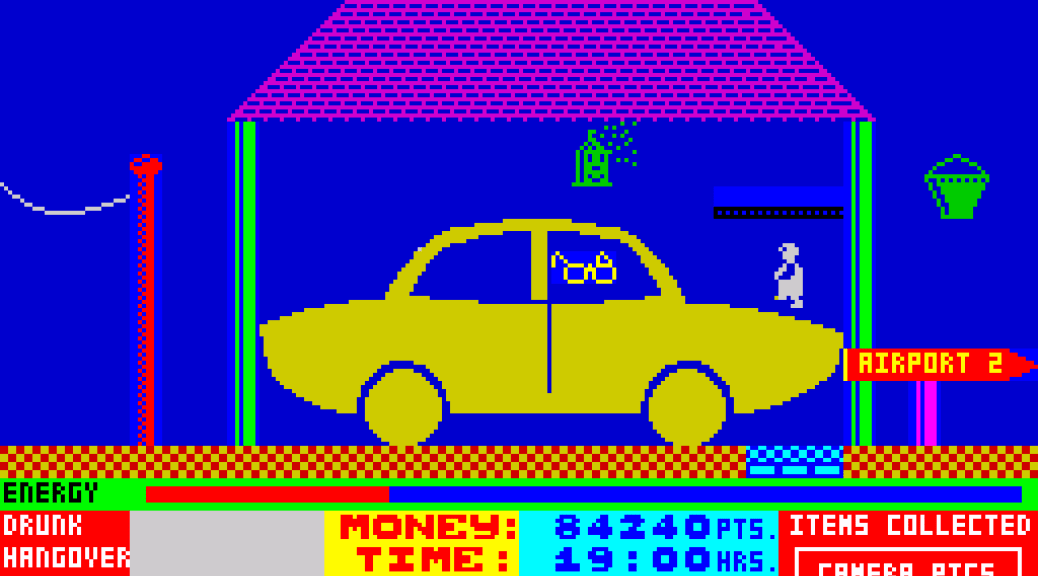
Costa Capers is the sequel to the classic Spectrum platformer, Technician Ted. The game was published by Firebird Software in 1985 and features similar gameplay to the original, with the same distinctive Ted sprite.
Costa Capers features more complex gameplay than Technician Ted. Not only do objects appear (and disappear) from the landscape as you complete tasks, but things change in the game at specific times too. Which makes completing the game much more difficult. And since the original Technician Ted was a very hard game, Costa Capers could be described as being ‘God-tier’ in terms of difficulty. It is still very playable, though.
The first thing you might notice is that the game has day and night cycles. You begin Costa Capers at 9am on the morning of 6th July 1985 (as shown on the information panel at the bottom of the screen), and at 8pm the sky goes dark – wherever you are. At 6am, the blue sky returns – unless you’re underground, in which case it’s always dark. This use of night and day was innovative back in 1985 – especially in a platform game. It’s not something you would see as often as you do today, and Costa Capers is one of the earliest examples of day/night cycles in a video game (although Forbidden Forest on the C64, which came out in 1983, also has them, as does 1984’s Knight Lore, so it wasn’t the first).
The aim of Costa Capers is to “enjoy your holiday in Spain” while “taking photos” of your trip. First, you must find a camera; then take 36 photos while on your journey; then take the resulting camera film to the developing shop at the end of the game. Which sounds easy when described in a couple of sentences, but in reality requires superhuman platforming skills to complete…
The main difference in Costa Capers, compared to Technician Ted, is that you can pick up items and carry them. In fact, this is a vital part of your mission. When you get hold of the camera, to take a photo of a location you must actually drop it in the right place, then pick it back up again, before moving on to the next place. The game does actually keep track of how many photos you’ve taken and displays this on the information panel at the bottom of the screen.
Ted can also pick up other items, and use them as platforms to reach otherwise unreachable areas. And – most importantly – dropping certain items (or simply possessing them) in certain locations makes things appear and disappear, to allow progress where before it wasn’t possible.
Costa Capers does feature some weirdness, like the sun shining at night on some screens, and the graphics are nice in places, but sparse in others. As a sequel, Costa Capers is reasonably interesting, but it’s also a frustrating, old school platform game that requires too much experimentation to figure out what you’re supposed to do next. This, combined with the many lethal traps and sprites moving around, makes it a tough prospect to complete.
In fact, Costa Capers is a game that is probably more interesting to watch someone else play and complete it, rather than do it yourself. If you want to do just that, there’s an RZX file on rzxarchive.co.uk, which shows exactly that. And if you want to try to complete the game yourself, the RZX ZIP file also contains a detailed analysis of the game, and the changes that happen in it (as a text file), which will save you having to work it out yourself.
See also: Technician Ted: The Megamix.
More: Costa Capers on World of Spectrum


2 thoughts on “Costa Capers, ZX Spectrum”