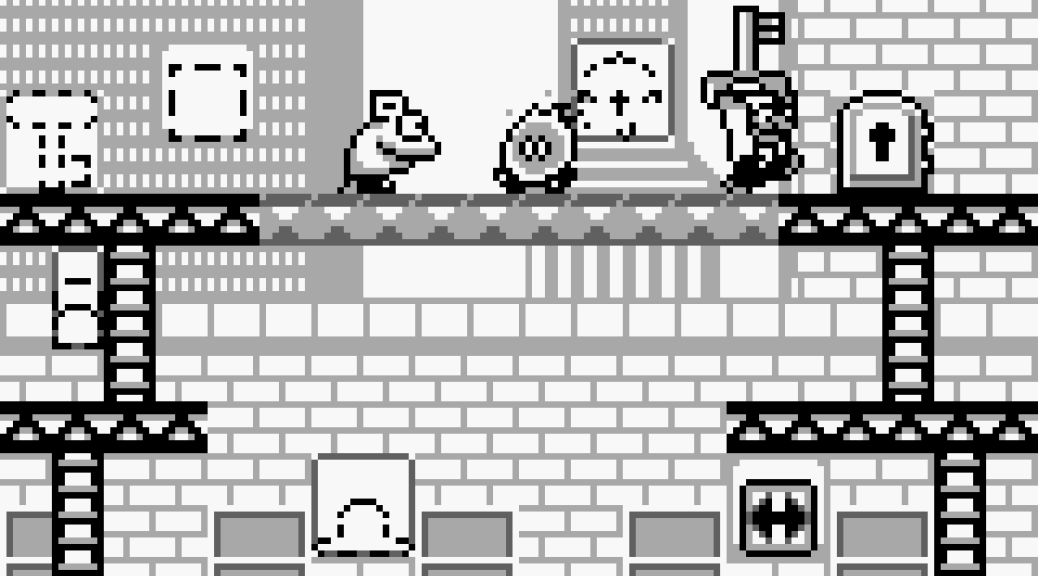
The 1994 Game Boy remake of Nintendo‘s iconic arcade game is something very special. It is an enhanced re-imagining of Donkey Kong that begins with the original game and then transforms into something amazing – a brand new game with nine themed stages and 95 individual levels.
Mario himself is given a slew of new moves, including handstands and backflips that allow him to jump higher than normal. He can also shimmy along wires and do wire spins on them, and crouch down to avoid hostiles from above. He can also pick up and throw objects, which is a major part of the gameplay.
After the introductory stage the aim becomes: get the key to open the door to the next level – within the time limit. These new levels can scroll both vertically and horizontally and feature many of the baddies seen in the original Donkey Kong, plus many others that only appear in this game, most of which must either be avoided or somehow killed. Killing baddies can be done by throwing certain items at them, or grabbing one of the classic Donkey Kong hammers and flattening them. Some enemies are useful, however, and don’t kill Mario when touched. These can be used to reach places you normally wouldn’t be able to get to.
Mario is a little more rugged than in the original Donkey Kong and can survive falling some distance. He’ll lose a life if he falls too far and isn’t holding anything, but if he has something in his hands (a key, for example) then he can survive being touched by an enemy or falling too far, but he will drop the item he’s carrying. However, he can’t walk up ladders with the key in his hands, so must sometimes throw it to upper platforms and then retrieve it before it disappears (once it’s thrown it will flash for a certain amount of time before it disappears and reappears back in its starting position).
Each level has three objects – an umbrella, a hat, and a purse – and collecting all three of these before exiting will give you the chance to win extra lives in a minigame between levels. There are two minigames: a spinning wheel and a fruit machine.
After completing a number of levels Mario will then have to contend with a ‘boss’ level against Donkey Kong himself, and these vary in their objectives. In the first encounter you must reach the top of a construction site and try to rescue Pauline once again. DK will occasionally jump up and down to make hazardous items fall down the screen, or to knock you off ladders. In the second encounter you have to pick up barrels rolled down platforms by DK and throw them back at him. The third encounter is a Donkey Kong Jr. tribute where you can climb up dual ropes. And so on.
Other features worth mentioning: the ability to ride on some enemies; enemies hiding inside trash cans; the ability to create temporary platforms and ladders; switches; trampolines; underwater swimming sections, and other new mechanics that are introduced gradually. There’s also a battery backup save and records for best times on all stages.
Overall, the Game Boy version of Donkey Kong (aka Donkey Kong ’94) is an outstanding game – maybe even one of the best released for the Game Boy. It features all the surprises, secrets, nuance and challenge that you’d expect from a modern Nintendo game, even though it’s almost thirty years old now (at the time of writing).
Donkey Kong is also Super Game Boy enhanced, and also plays in colour when plugged into a Game Boy Color. If you want to see the Super Game Boy version (which is excellent by the way), click here.
More: Donkey Kong (Game Boy) on Wikipedia
More: Donkey Kong (Game Boy) on mariowiki.com
More: Donkey Kong (Game Boy) on romhacking.net


 The King of Grabs
One thought on “Donkey Kong, Game Boy”