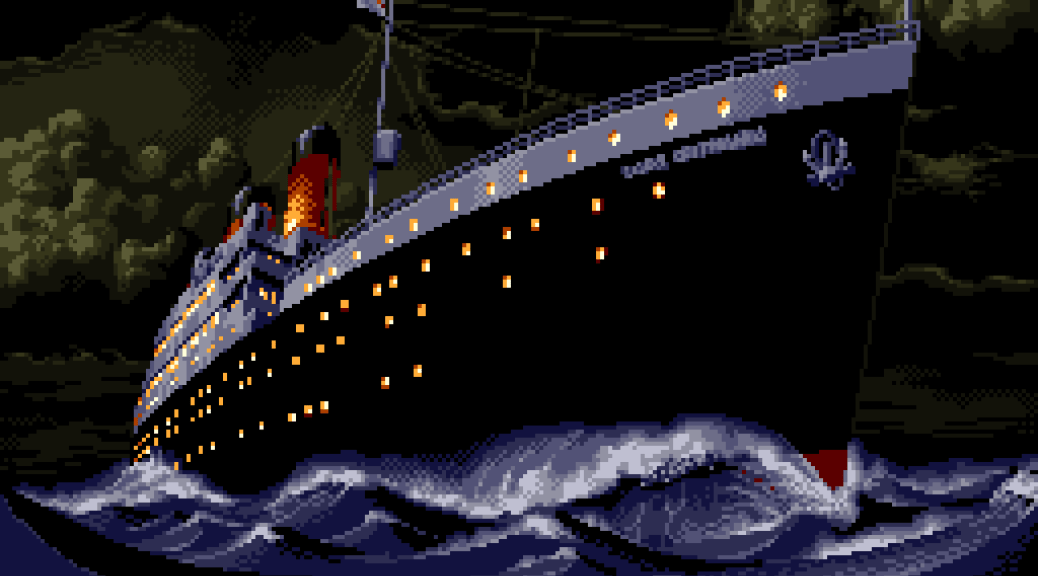
SOS is an intriguing survival adventure game set on a sinking ship in The North Sea, in 1921. The game features four playable characters, each with a different story, although the ultimate aim is the same for all of them: to escape from the stricken Lady Crithania, which has been hit by a gigantic wave and has capsized off the coast of England. SOS was developed by Human Entertainment and published exclusively for the Super Famicom by Field Co. Ltd. in 1993 (1994 in North America; published by Vic Tokai). In Japan the game is known as “Septentrion“.
SOS is loosely based on the 1969 book and 1972 film, The Poseidon Adventure, with elements of the Titanic story thrown in as well. It is played in real-time and you have exactly one hour to make your escape from the ship, along with as many survivors as you can find.
The four playable characters each have their own introductions and path through the game, and also their own individual objectives. The four characters are: Capris Wisher (an architect who is with his younger stepsister on the ship, Amy Markarson); Redwin Gardner (a counsellor, traveling with a his unnamed mother and her children Stella and Harry Adams. Plus, Jack Hamilton, a nephew); Jeffrey Howell (a senior doctor, travelling with his wife Adela); Luke Haines (a crewman of the Lady Crithania. He suspects that the sea conditions are too much to handle, and is opposed by his superiors).
Each survivor you meet has a points value, which can vary depending on who you’re playing, and getting them to follow you requires something specific to happen, which you have to figure out.
Climbing and jumping play a crucial role in the gameplay, as does time, because specific events will happen to the ship as the timer ticks away. The ship will begin to list at certain points (all shown in glorious Mode 7), and some areas will also begin to fill with water, which adds to the sense of urgency. Your character can crouch and climb up any surface that is less than vertical, and can also jump to grab ledges and pull themselves up (or lower themselves down). Doors can be opened, and items can be manipulated, by pressing the ‘action’ button, and the ‘communicate’ button allows you to talk to people. Pressing the L and R buttons will issue a shouted “come here!” command to any survivors following you.
The timer is hidden, except when your character is injured, in which case you fall unconscious and lose five minutes and the timer will be shown briefly.
SOS has multiple endings, but to get the ‘good’ ending for each character you must rescue their “sentimental person”, plus the maximum number of high-value survivors.
It does take a while to get into SOS, but it is an interesting and unique game that is still worth playing today. Escaping the ship is a challenge, and the tension created by the ever-decreasing timer, and the gravely serious situation and dialogue, is palpable. Getting the ‘good’ ending will take a number of replays, and maybe a peek at a guide or two, but it’s worth the effort if you find yourself liking the game.
A sequel to SOS was released in Japan in 1999 for the PlayStation, called Septentrion: Out of the Blue.
More: SOS on Wikipedia
More: SOS on YouTube


 The King of Grabs