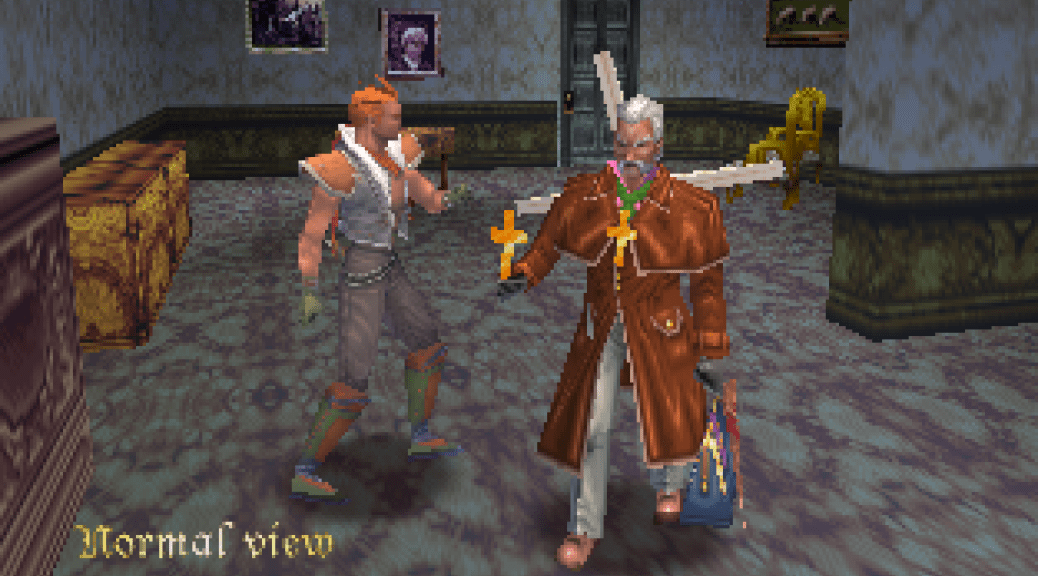
Developed by Konami‘s Kobe division and first released in 1999, Castlevania on the N64 (sometimes referred to as “Castlevania 64“) is a third-person 3D game – the first 3D game, in fact, in the popular horror/platform/action series.
Castlevania on the Nintendo 64 is set in the year 1852 when Dracula has risen again. You take control of either Reinhardt Schneider (the whip-wielding heir to the Belmont clan), or Carrie Fernandez (a young orphan gifted with magic powers), who have sensed Dracula’s return and have set out to locate and destroy him.
The gameplay in this game is considerably different to previous Castlevanias – it being an over-the-shoulder 3D game – although it does still have most the hallmarks of the series, like whip-based combat; primary and secondary weapons; platforming action; classic horror-themed monsters; creepy castles; deadly traps, and boss and sub-boss battles.
New to the series in this game are: Tomb Raider style platforming and climbing; auto aiming (which is useful and probably necessary); switchable view modes; day and night cycles, and time-sensitive game progression.
Taking each one of the above features in turn: jumping towards a ledge above you and holding down the jump button allows you to grab it, then pushing up will make you climb it. You can also shimmy across a held ledge by pushing left and right. On the downside: falling too far, into water, a ravine, or the ground from height, will lead to instant death, which is something you have to be careful about. All on-screen enemies have a hit box showing when they are targeted (yellow ones on common enemies, and red ones on bosses and sub-bosses). The auto aiming makes it easy (and satisfying) to quickly turn around and whip enemies behind you. In a 3D game like this the camera viewpoints are important, and the game will automatically switch between normal, action, and boss views, depending on what’s happening in the game. Plus you can also go into first-person view mode temporarily, although you can’t move when you’re in it. The day/night cycles actually have a use in the game as the game counts how long it’s taken you to reach certain waypoints, and changes the gameplay depending on how long it’s taken you to reach them. For example: if you take sixteen or more in-game days to reach Charles Vincent inside the castle it will trigger the bad ending, and conversely: if you reach Vincent within fifteen in-game days a different sequence of events will unfold, triggering the good ending. There are other time-sensitive elements too (like doors that will only open if it’s day or night, and staircases that only appear at midnight), so it might be worth reading a guide before embarking on a playthrough. And, of course, there are also different endings depending on which character you’re playing as.
While Castlevania on the N64 is playable and well-presented, with atmospheric effects like rain, lightning, fog and coloured lighting, it does have a few niggles. The constant re-spawning of enemies can be tiresome, especially when it keeps happening next to save crystals. While enemies are supposed to re-spawn in Castlevania games, it usually happens when you leave – then re-enter – a room or area, but in this they just keep coming out of the ground constantly and it just seems a bit too much at times (especially when you are in an area where suicide bomber enemies are spawning). It’s also a bit fiddly having to press a button to pick items up off the ground, because they fade away quite quickly, so you have to grab them before they disappear. Making sure you’re stood in the right place to pick something up can be tricky. Just running into and touching an item should be enough, as is it in previous Castlevania games.
There are also some weird/borderline over-the-top elements that made me wonder if the game’s designers had lost the plot, like the skeletons on motorbikes… Yes: skeletons on motorbikes! While I suppose “anything goes” in a Castlevania game, there are some things that do make you question what you’re seeing. Some of the boss fights are a little underwhelming and weak too (not all of them, though – some are excellent).
There are unfortunately no other playable characters to unlock, although there is an expanded version of this game – with Reinhardt and Carrie, plus a few other playable characters – included in the prequel, Legacy of Darkness, which was also released in 1999.
Overall, Castlevania 64 is not a bad game. It can be annoying at times – usually when you plummet to your death by accident and have to re-load – but the action is fairly enjoyable when you get into it. This game doesn’t contribute a great deal to the series, but it does at least make a reasonably good attempt at transitioning to 3D gameplay.
More: Castlevania 64 on Wikipedia


 The King of Grabs
3 thoughts on “Castlevania, Nintendo 64”