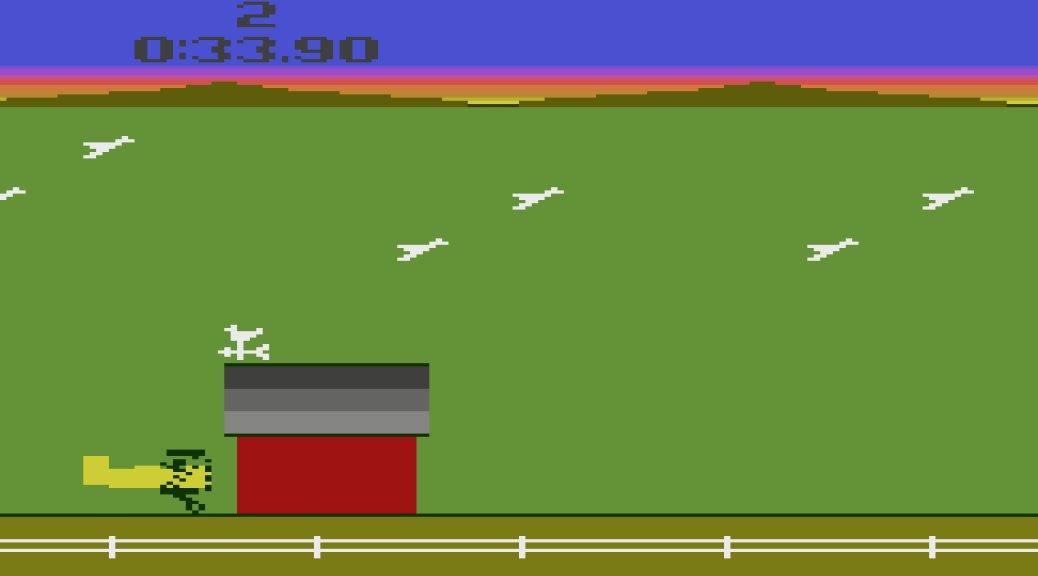
Barnstorming was designed by Steve Cartwright and first published by Activision in 1982. Like most people who play it for the first time, I had to check if I was playing the game as intended, because there’s so little to it.
You fly a biplane, on a scrolling screen, which must avoid obstacles (birds and windmills), and fly through a series of barns in the quickest time possible. There are four courses in total, three on increasingly-longer courses that stay the same, and can therefore be memorised. The fourth (and longest) course is random, and requires the highest number of barns be flown-through.
After take-off, you can hold down the fire button to get a boost in speed, but must also be careful not to use this booster to crash into things. The game manual says that it is possible to make it through these courses at full speed, but in practise that is not an easy task.
When the plane hits a bird, or windmill (or anything else that it can’t pass through), it bounces backwards and loses momentum for a second or two, before flying on. Which is funny in itself (that video games can so readily ignore the laws of physics if they want to). Not so funny, however, is that that is pretty much all there is to Barnstorming. Aside from figuring out that moving vertically will lose you time too. So the aim is to reach the finish line with as little movement as possible, and also with optimal use of the boost button*.
As I said above: I had to go check (by reading the manual and watching a couple of longplays), that I wasn’t missing anything, and it doesn’t look like I was. The box art for Barnstorming goes out of its way to show the biplane looping (with an Activision rainbow loop trail), but that just seems deceptive to me. There is no looping in this game.
Personally, Barnstorming is not my cup of tea, but it’s nicely presented and is playable, and I can at least see the appeal of it to race game fans.
*= Barnstorming was inadvertently embroiled in the alleged cheating scandal at Twin Galaxies (which used to be the de-facto organisation keeping historical high scores and gaming world records), when a time of “32.04” was posted by a guy called Todd Rogers. Fans of the game doubted this was even possible, without using a hack, and this has since been proven beyond doubt. Since then, all of Todd Rogers‘ historical high scores have been doubted as “impossible“, a contributing factor to the downfall of the validity of historical video game high scores.
More: Barnstorming on Wikipedia


 The King of Grabs
Just had a go on this. The only reason it was brought to my attention is because I run a Discord that runs some leaderboards that integrate with some retro games, and someone posted some times on this so I thought I’d challenge their times despite never having heard of it. I have to say that’s probably about the most interesting thing I could say about it – without that, there’s really not a lot going for it. The repetitive positioning of the barns and windmills make the game feel static as hell, and the birds on the higher difficulty levels became so plentiful that I started to doubt whether it was worth even trying to dodge them and instead just plow through them at max speed, given the fairly minimal penalty for hitting them. Really, this probably would’ve been more interesting as a vertical game rather than horizontal, and made it feel more dynamic in the process.
I agree the box art is doing a lot of the heavy lifting here.
No idea why, but if you stay on the main screen for 25mins, the colour palette of the game changes. Not sure if intentional or something ticking over in the logic.
LikeLiked by 1 person