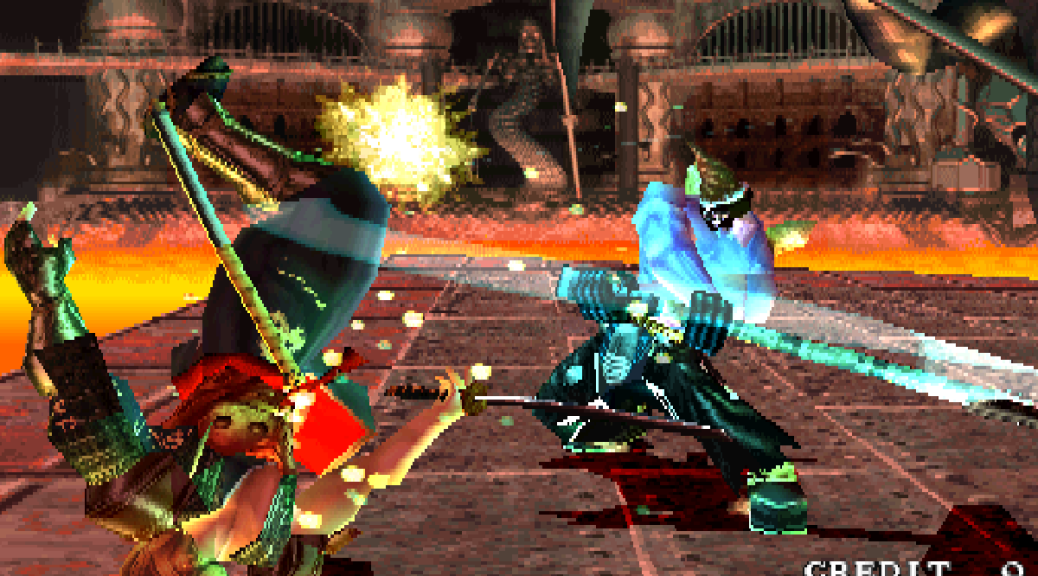
After the arcade game, Soul Edge in 1996, and the PlayStation conversion of that game in 1998 (called “Soul Blade” in the West), came Soulcalibur in 1999. It was made available in arcades first, as a two-player cabinet, and did reasonably good business.
The basic storyline is about a group of fighters battling it out for possession of a mystical sword called “The Soul Edge“.
Soulcalibur was based on Namco‘s System 12 hardware, and it definitely looks like it was a game that came from the “CRT monitor, standard-definition” age of arcade gaming… The screen resolution is quite low (less than 640×480), but the colour reproduction and special effects, animation and frame rates are top-notch. Which are areas where Soulcalbur excels (unsurprisingly).
The character models are therefore all excellent. Arguably ‘best in class’. In total there are ten playable characters to choose from: Arthur, Astaroth, Hwang, Ivy, Kilik, Maxi, Nightmare, Sophita, Taki and Voldo. Nine of the eleven characters from Soul Edge were carried over to Soulcalibur. Maxi is the only new character.
Two things that don’t play a significant role in Soulcalibur are: jumping and blocking. Characters don’t jump around a great deal, and there isn’t even a jump button. The fighting here is mostly footwork and sword work. You can block, but not overtly. Which I found rather strange, and it makes Soulcalibur much more about attack than defence. It can also result in bouts that are over very quickly…
The visual effects accent the swishing blades extremely well, and the camera movement is so good that you forget that you’re playing a video game. The fighters all display an array of athletic moves, and there’s very little “magic” in the game, making the focus on spectacular sword fighting.
What made Soulcalibur stand-out at the time was that it was one of the first games to use Motion Capture (Mocap) effectively. For the animation of the fighters. Namco also did a great job with the actors, making Soulcalibur a graceful fighting game, with less emphasis on violence and magic, and more emphasis on movement and skilful weapon techniques.
An enhanced version of Soulcalibur (with ten new characters) was released for the Sega Dreamcast that same year.
Something indicated to Namco that there might be something special going on with Soulcalibur, so they continued the series and produced another sequel fairly quickly, releasing the hugely popular Soulcalibur II in 2002.
iOS and Android versions of the emulated arcade Soulcalibur were released in 2012 and 2013 respectively.
Soulcalibur Arcade = 10 playable characters:
Arthur, Astaroth, Hwang, Ivy, Kilik, Maxi, Nightmare, Sophitia, Taki, and Voldo. Unlockables? Unknown.
More: Soulcalibur on Wikipedia


 The King of Grabs
3 thoughts on “Soulcalibur, Arcade”