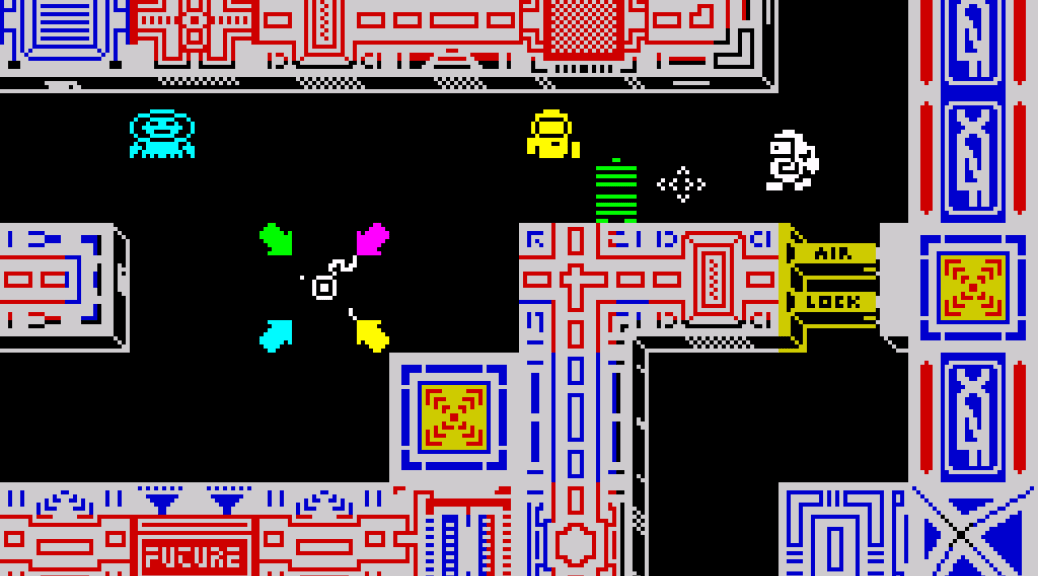
Programmed by Dominic Wood, with graphics by Julian Wood, Project Future is a colourful action/maze game that was published for the ZX Spectrum and Amstrad CPC by Micromania in 1985.
In Project Future, you play as Space Cadet Farley, who is sent on a mission to activate the self-destruction system on board the gigantic spaceship, SS Future. The SS Future has five different decks, interlinked by teleporters, and the ship as a whole spans exactly 256 screens.
To initiate the self-destruct, you must find and collect eight different codes; then find and press the destruct switch, and then escape the ship before detonation. Each code is randomly scattered around SS Future and looks like a coloured, square lozenge. When collected, each code is shown as a small square on the information panel at the bottom of the screen.
Space Cadet Farley can shoot hostile sprites using his plasma gun, but destroyed enemies quickly re-spawn, so you have to be very careful when moving around because a single touch of anything hostile will lose you a life. To compound matters, it is also fairly easy to get stuck on the scenery, and a split-second mistake with movement can cost you a life. It is worth backing off on occasion, and timing your movements through enemy bottlenecks with care.
There are a number of useful items scattered around the decks of SS Future, such as invincibility suits (that give you a short period of protection if you find one), and even a jet-powered C5 (that you ride as a vehicle and will speed up your movement, as well as offering some protection against hostiles).
Teleporters are vitally important to your mission, and the direction you enter a teleporter dictates where you’ll come out.
Project Future is a game that really requires a map to make progress in, but even with a map it’s quite difficult to find your way around, because the maze is pretty tortuous. I remember playing this game a lot in my teenage years, and trying to make a map, but I ended up failing because the maze was too complex. I still enjoyed playing Project Future, though, even thought I never beat it.
Project Future is currently available on the retro gaming service, Antstream (at the time of writing).
More: Project Future on World of Spectrum


 The King of Grabs