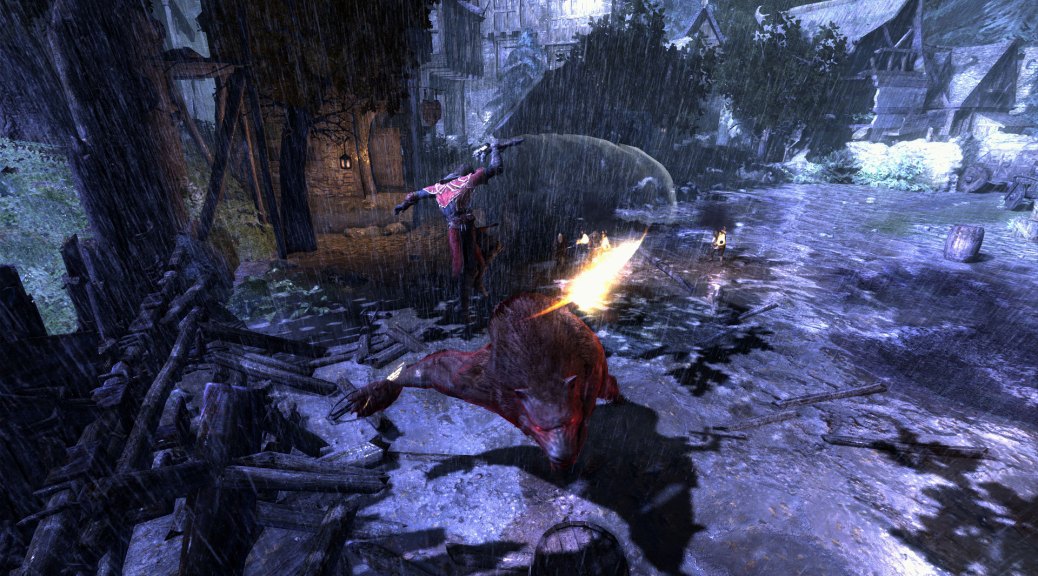
Castlevania: Lords of Shadow is a “reboot” of the Castlevania series, developed by Spanish studio MercurySteam and first published by Konami in 2010. Hideo Kojima, creator of the Metal Gear series, helped produce the title.
In Lords of Shadow you play as Gabriel Belmont, a member of the Brotherhood of Light, an elite group of holy knights who protect and defend the innocent against the supernatural. His quest is to defeat a malevolent order known as The Lords of Shadow, and to resurrect his dead wife, Marie.
The game is a third-person action game, with a viewpoint that changes depending on the situation. In the PC version (the one shown here), the controls are all via the keyboard, or a gamepad, and Gabriel must fight his way from one dramatic scene to another, through a total of fifty different levels. Progress is mostly linear, although there are some branching paths, and you’re encouraged to explore to find hidden items.
Gabriel wields a chain whip, called The Combat Cross, that he uses in various ways. He can of course attack enemies with it, but can also swing over gaps with it, use it to block enemy attacks, or perform ‘saves’ to avoid traps or pitfalls. The Combat Cross can be combined with the Light and Shadow magic system, which are spells aimed at defence and aggression, respectively. The whip is also upgradeable, and can be used to perform ‘combos’, of which there are 40 unlockable instances. To unlock these (and upgrade other stats and weapons), you earn Experience Points from combat, and can collect and spend them as required.
You can also use secondary weapons, such as knives, holy water and other items, all of which are limited use and can be upgraded if necessary. All upgrades, maps, backstory notes, the bestiary, and other important game-related information, are accessed through Gabriel’s Travel Book, which is shown by pressing Backspace (or whatever key or button you bind it to), in the game, or during intermissions.
The game has three difficulty settings (Squire, Warrior and Knight), with a fourth that is unlockable (Paladin), after completing the game once. Combat is relatively challenging, mostly because Gabriel’s health is such that he can only take three or four serious hits before dying. You can refill his health at a Health Font (glowing etherial pedestals), but these must be found by exploring. Two important components of combat are: dodging and blocking. Using the dodge key makes Gabriel roll along the ground, and hopefully away from an attack. Blocking requires that you press the dodge key at the exact moment a hit will land. If done correctly it will stop an attack dead, and give you the opportunity for a counter. You can also grab certain enemies and pummel them to death – if you are able to time a reaction correctly. These Resident Evil 4-style reaction moves crop up throughout the game, in various situations, and they’re mostly shown as a larger circle, shrinking down into a smaller one. The idea being: that when the larger circle eventually enters inside the smaller one, that’s when you have to press the attack button. Some reactions require specific key-presses though.
The action in Lords of Shadow is dramatic, gritty, and varied. There are horse-riding sections, where you have to fight off enemies riding Wargs, running alongside you. If you’re knocked off, you then have to fight off a group of enemies, before getting the chance to re-mount and continue; there are monsters in the swamp that will try to drag you under and drown you, unless you react accordingly; and many other traps and monsters. There are also a wide array of boss and sub-boss battles, including fights against large scale bosses known as ‘titans’. At times, Lords of Shadow seems a lot like a Resident Evil game (except without the guns), and occasionally a bit like The Witcher 3, because the main thrust of the gameplay is mostly combat.
Lords of Shadow features gorgeous, detailed, 3D graphics, with lots of atmospheric special effects. The soundtrack is also dramatic, with orchestral themes, mixed with choral passages. And the voice acting is impressive too. Gabriel Belmont is voiced by Scottish actor Robert (Trainspotting) Carlyle, and the narrator of Lords of Shadow is the instantly recognisable Patrick Stewart (of Jean Luc Picard fame). So some pretty heavyweight voice actors worked on this game. Overall, the presentation gives Lords of Shadow a feeling of awe and grandeur, and – at times – of dread and fear.
I have seen people criticising this game for “not being a proper Castlevania game” – claiming that it was being developed as something else, but was later turned into a Castlevania title, but I’m not sure about that. Konami did initially announce the game, without saying that it was a Castlevania reboot – apparently so as not to upstage the release of the Wii game, Castlevania Judgment. Which seems plausible to me. Having played Lords of Shadow extensively, I have to say that it felt like a Castlevania game to me, and I thoroughly enjoyed it. That said: I still prefer the best of the 2D Castlevania games, including Symphony of the Night, Rondo of Blood, the three GBA games, and the three DS releases. But Lords of Shadow is still a decent reboot in my estimation.
Lords of Shadow was also released for the PlayStation 3 and XBox 360, and also spawned two sequels – Castlevania: Lords of Shadow – Mirror of Fate (2014), and Castlevania: Lords of Shadow 2 (also 2014).
More: Castlevania: Lords of Shadow on Wikipedia
Steam: Castlevania: Lords of Shadow on Steam


 The King of Grabs
3 thoughts on “Castlevania: Lords of Shadow, PC”